
Health, Behavior, & our Big 5
This section should answer any questions you have about our behavioral or health screening programs, and what is important to us in these areas. You can find detailed information on individual dogs on their page.
It’s so easy to think that parents and pedigrees aren’t that important unless you are looking for a show or sport prospect, after all it’s just a list of names! But the truth is that genetics are what determines much of the potential your puppy will possess, both good and bad. The traits needed to be a good healthy companion dog are largely inherited, just like the traits needed to be a top show or agility dog, so that pedigree really matters.
Behavioral and health predispositions move through pedigrees like water down a river, constantly moving and changing over time. Traits from generations back can show up in every generation, or pop up after traveling along below the surface for decades.
This means the better understanding a breeder has of the dogs and traits present in their pedigree, the better able they are to predict the strengths, weaknesses, and talents of the dogs they produce.
Ideally a breeder should be able to discuss with you what it was/is like to live with many or most of the dogs in their pedigrees. This information is vital for those seeking an easy companion prospect. Unhealthy, difficult, dangerous, and/or high strung dogs make difficult, dangerous, and/or high strung descendants. It’s the job of the breeder to know the dogs in their pedigrees so they can modify undesirable traits through selection pressure over generations. Equally important is being able to communicate these traits to you, so you can understand what the predispositions of your puppy may be.
In the name of transparency and communication we use a simple scoring system to plot our breeding dogs, and litters, important heritable traits of health based on FCI and GSDCA recommended screenings. For behavior we use our own system, using breed typical traits so you can clearly and easily look at a parent dog, or their breeding, and see if the expected traits are going to be a good fit for your needs and desire for a pleasant GSD companion. These are based on our extensive experience with the breed and our program dogs, as there is no worldwide system for behavioral health as there is for physical health.
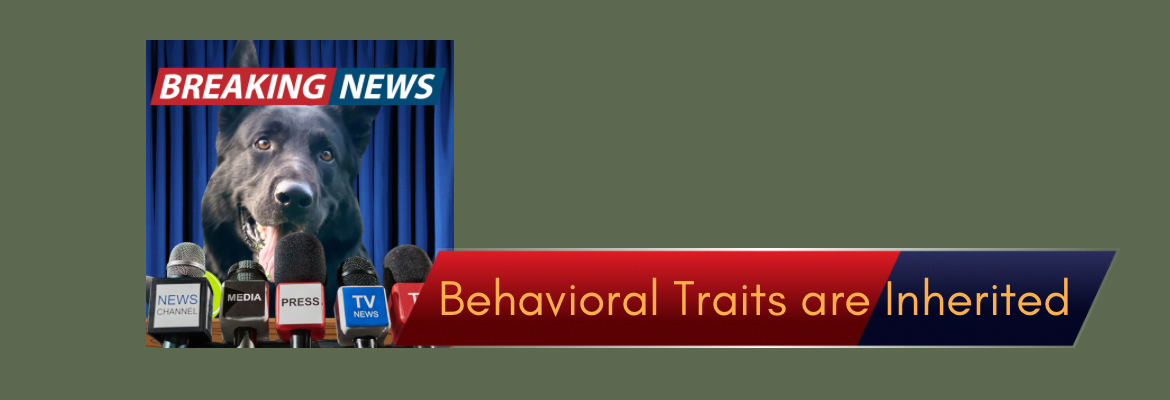
The predisposition to particular behavioral traits is inherited and moves through generations of dogs. As we seek to produce German Shepherds with the traits and talents to make outstanding companion dogs we have given preference to behavioral traits that are desirable in the companion dog.
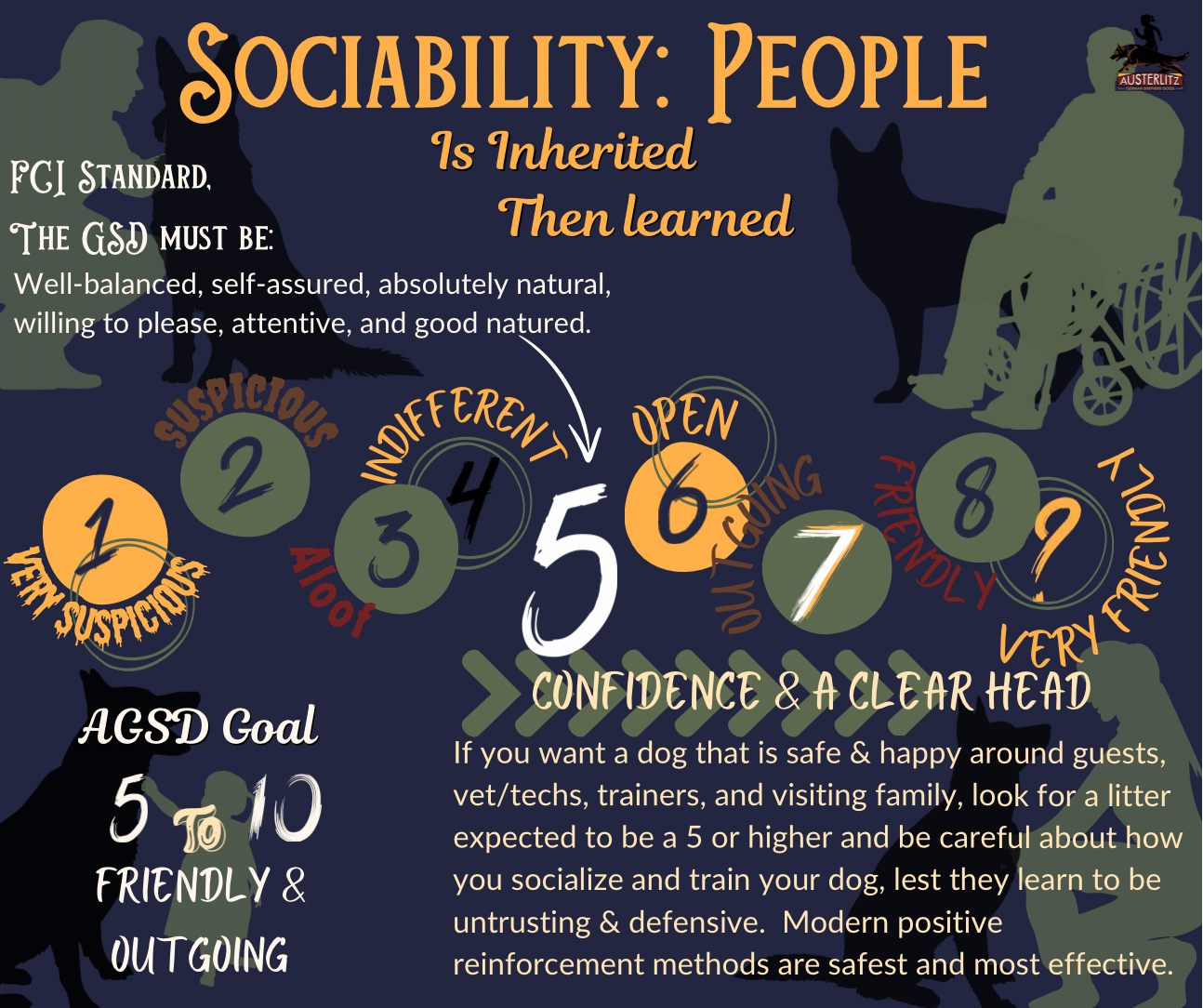
1. Friendly and Pro-Social Disposition: While some of our breeding dogs are downright outgoing and friendly, others take a little longer to warm up to new friends. Both are correct to our breed standard. What we do not include in our program are dogs who are uncomfortable and/or lack confidence when making new friends. Dogs who are described as “aloof” or “standoffish” are often at a higher bite risk when living in companion homes. Anti-social dogs are not only more likely to bite those you invite to your home, and sometimes even family members, they are sometimes a bite risk when receiving medical care, grooming, or boarding. We know that our clients prefer to live with confident and stable companion dogs who are tolerant and friendly towards caregivers, friends, and those they may encounter while living an active life.
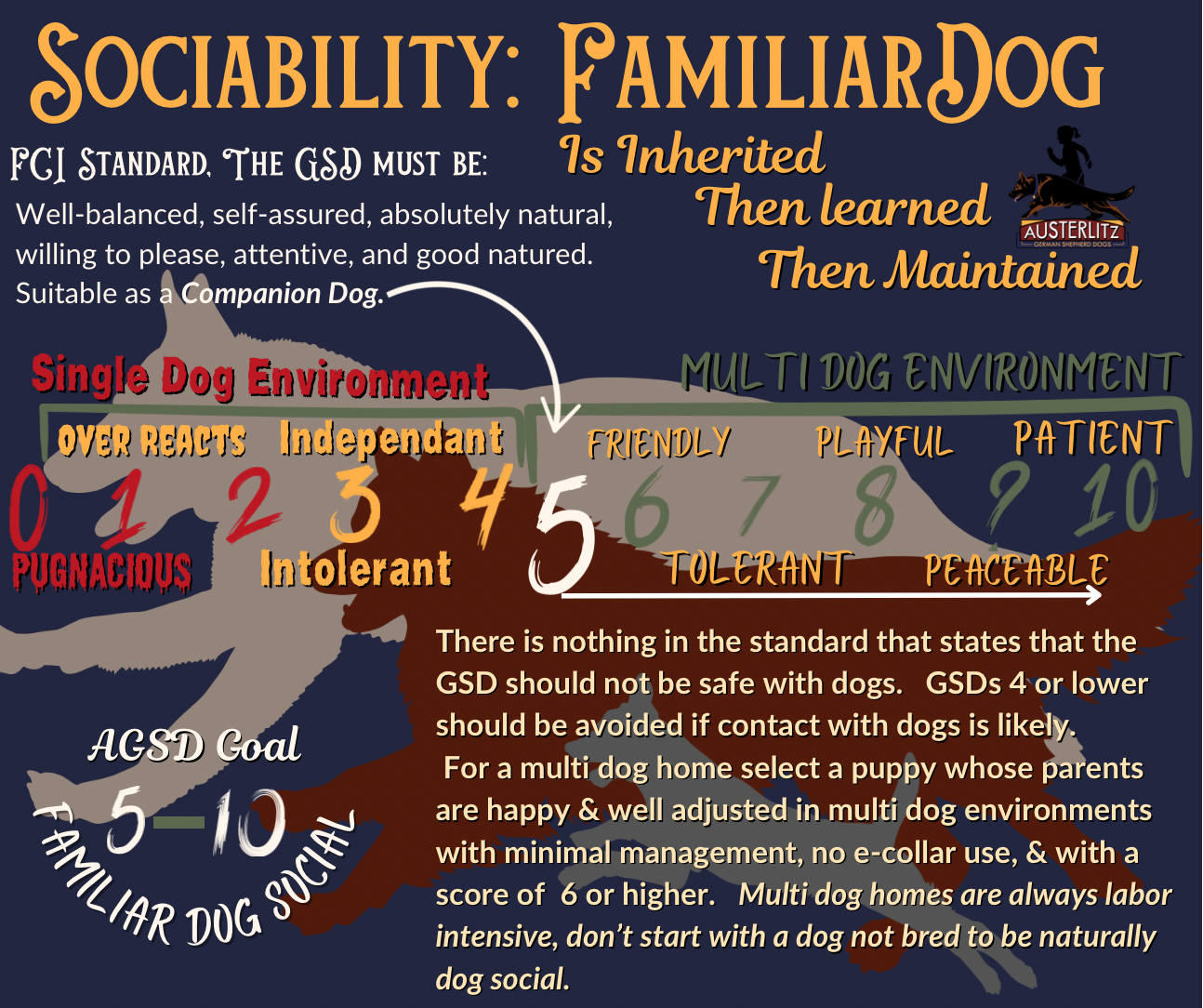
2. Dog Sociability: In modern times the breed has become increasingly anti-social towards other dogs. This is not correct or desirable for a German Shepherd, but we do see these faults of temperament widely across the working lines in particular at this time. We know that companion dogs must be tolerant of possible of housemate dogs, as well as unknown dogs they might encounter when they are out in public. While the German Shepherd doesn’t need to "make friends" with every dog they see, or tolerate aggressive behavior from other dogs, there is no reason this breed cannot use good judgement and tolerance when faced with benign dogs they meet or encounter.
Our dogs live together and while some are more selective of who their “best” friends are than others, none present a danger to other dogs, are pugnacious, intolerant, or lacking in functional social skills. We value social skills and good judgement in our dogs, and apply selection pressure for dogs who can navigate life with a minimum of ”top down” control over their choices and little or no management.
We don’t want to live with a hair trigger, impulsive, dog who requires constant micromanagement to prevent bad choices, and we don’t think our clients want that either. We do not include these types of dogs in our program, and do include dogs with an abundance of common sense and a nature we can trust.
We know how important it is to our clients that their dog does not inherit a predisposition to unwarranted aggression towards other dogs, so we do not include such dogs in our program either, and our dog’s lifestyle of living together instead of separated into kennels allows us to fully understand each dogs core sociability traits.
We use a scoring system to help you identify how outgoing and gregarious an individual dog is towards known dogs, and what to expect “on average” for each litter. As puppies grow, we rely on our daily interactions and observations of each puppy to inform us as to how socially skilled a puppy is at this developmental stage. However, full social maturity is required for complete understanding of the dog’s nature.
You will find a Sociability Number for each breeding dog and their litter, this will help you gauge if a particular litter might be a good match for your needs and preferences.
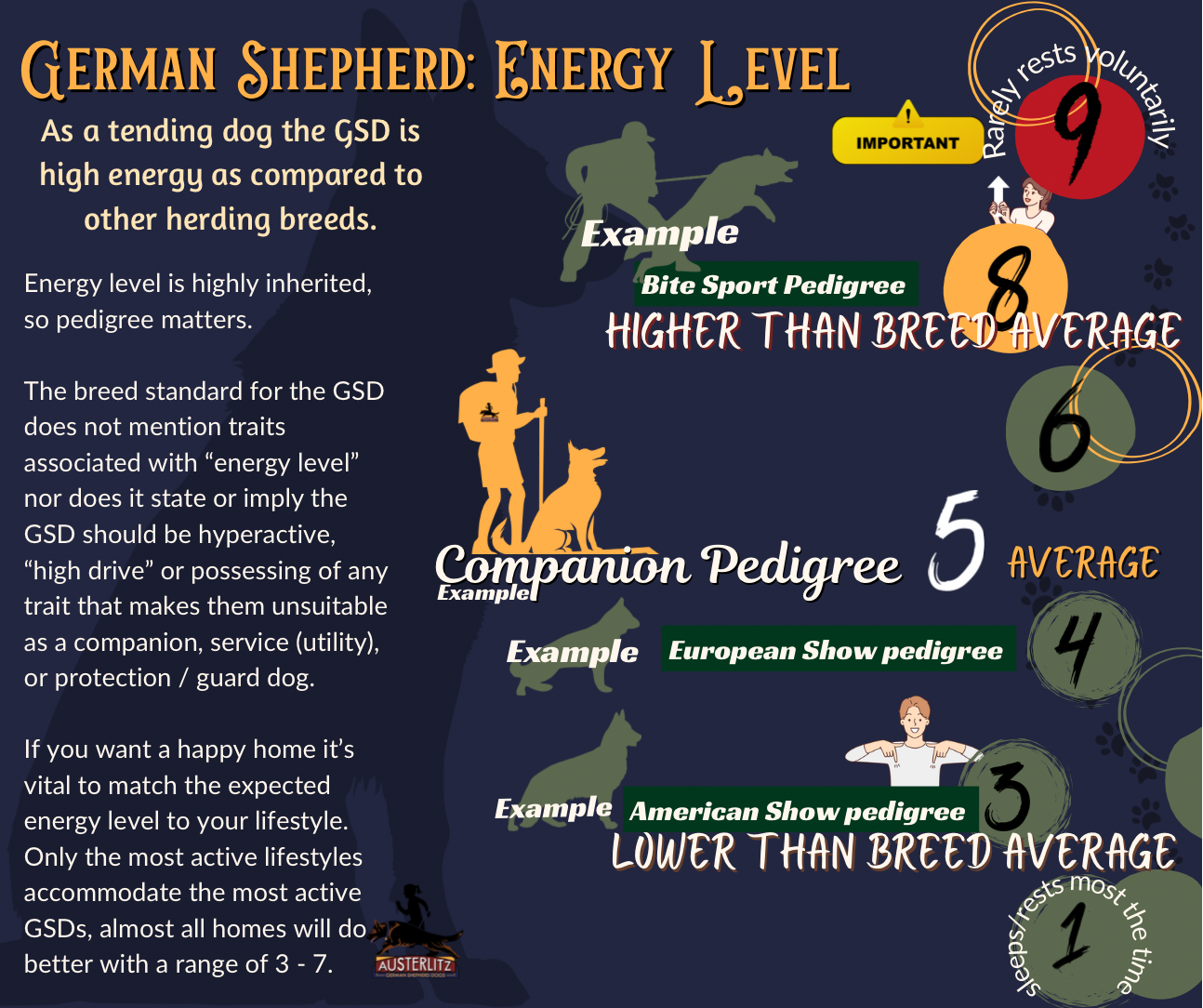
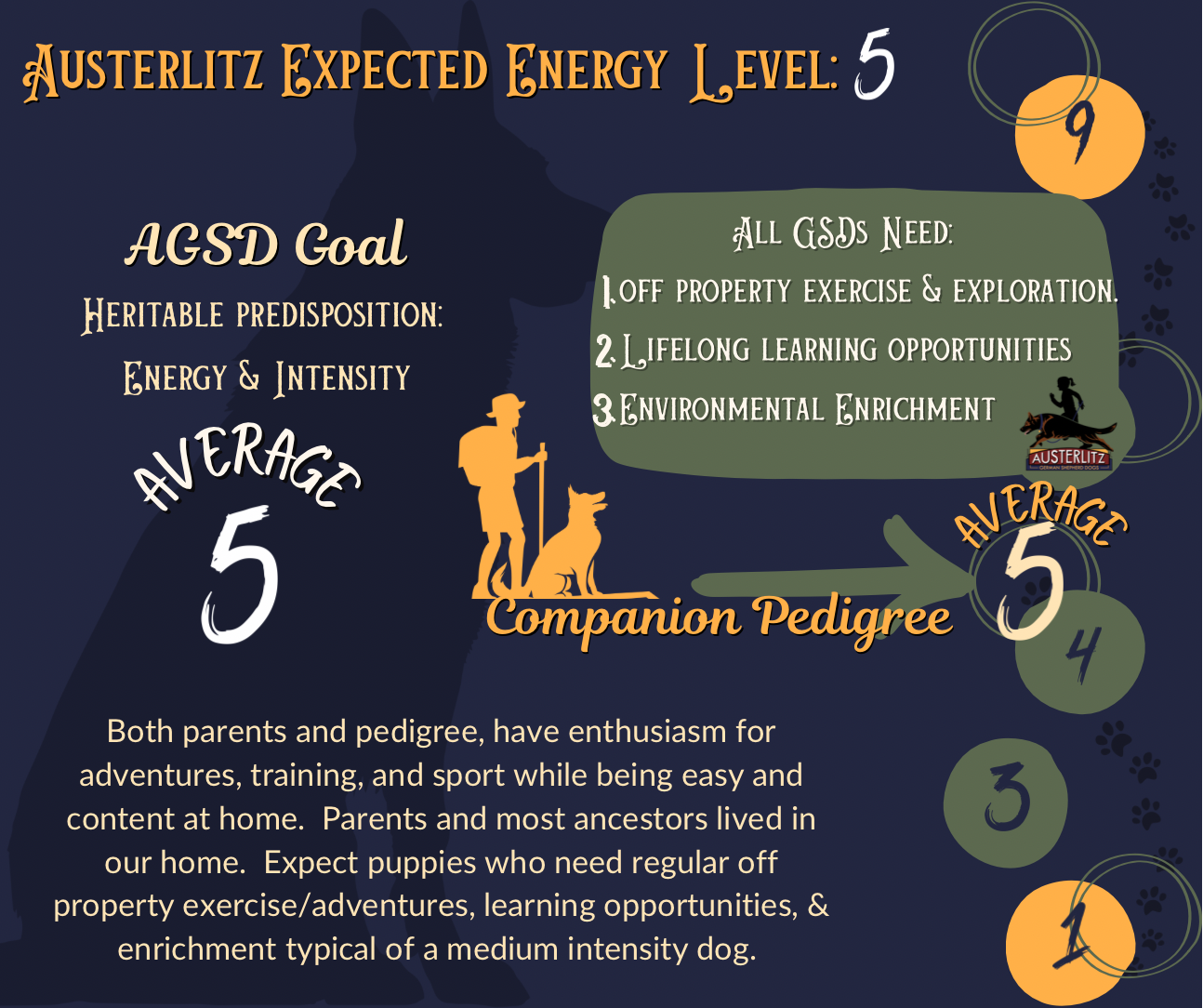
3. Energy Level: This is also inherited, and we don't want to live with hyperactive dogs any more than you do. In fact nobody wants a dog in their house without an “off switch” (an inability to rest on their own, a hyperactive dog) - many dogs like this were never intended to be kept in a home, rather are expected to live in crates or kennels primarily.
High energy and “high drive” are often used as synonyms but in reality they are not the same thing. However, avoiding "high drive" labeled dogs is a good way to avoid ending up with a companion dog with an unnaturally high energy level and hyperactive nervous system.
We have a scoring system we use to help communicate to puppy seekers the energy level of a particular parent dog and also what we expect for that litter.
Our goal is to produce dogs who have natural and normal energy levels and exercise needs for this breed. While the German Shepherd is an active breed that thrives with a buffet of exercise and enrichment choices, they should not be hyperactive and unable to calmly settle. We never include dogs in our program who require “forced” calm down times (tethered to the wall, forced to stay on a station with an e collar, kenneled, or crated) because they cannot simply choose to rest when needed nor do we include dogs who must run on treadmills, beside bicycles, or be worked to the point of exhaustion in order to be calm. We know our clients do not want a hyperactive GSD anymore than we do so we will not include such dogs in our program.
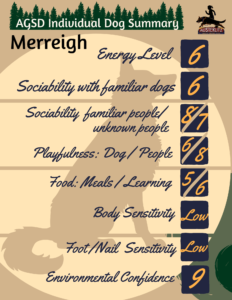
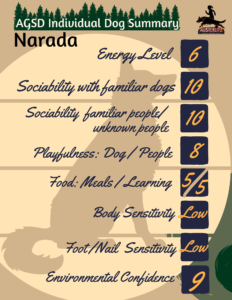
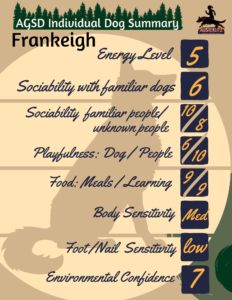
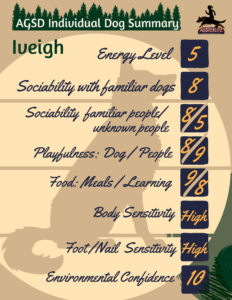
4. You will also find each breeding dog will have a score for other miscellaneous presumed genetic traits. While these are not inherited in a clear way that is currently understood, or can be tested for via DNA testing, the community does agree that in some degree the predisposition can be passed to offspring, or even pop up multiple generations later. Since this group of traits may be relevant to some of our clients we do track them and score them to help you understand the disposition and personality of parent dogs and to help us reduce undesirable traits in our program.
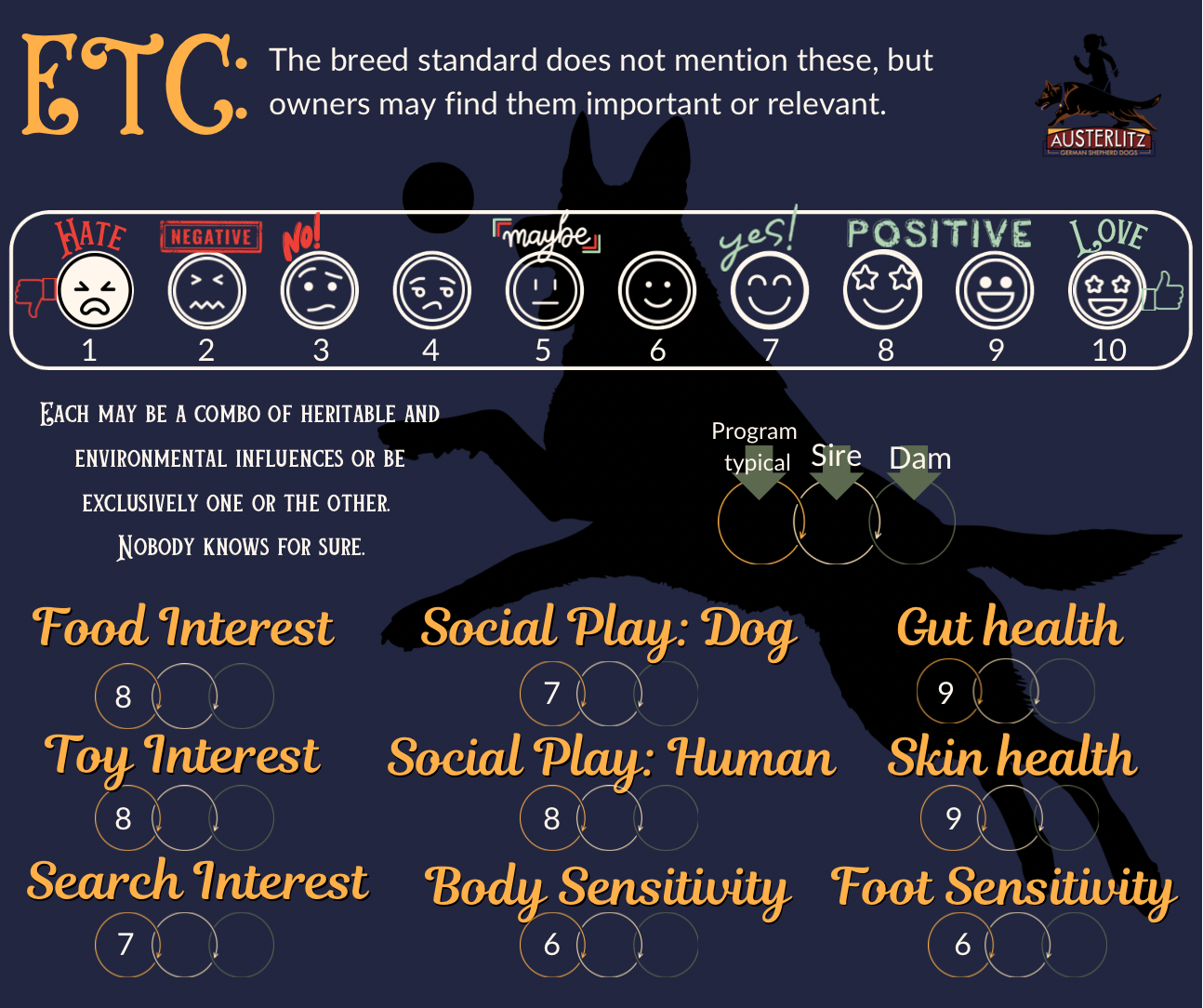
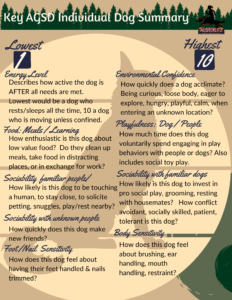
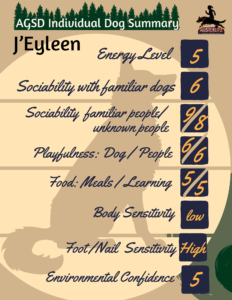
Here is a sample of an individual dog’s scoring of miscellaneous traits of interest as well as a key that explains what we are describing. These pages can be found on each dog’s page.

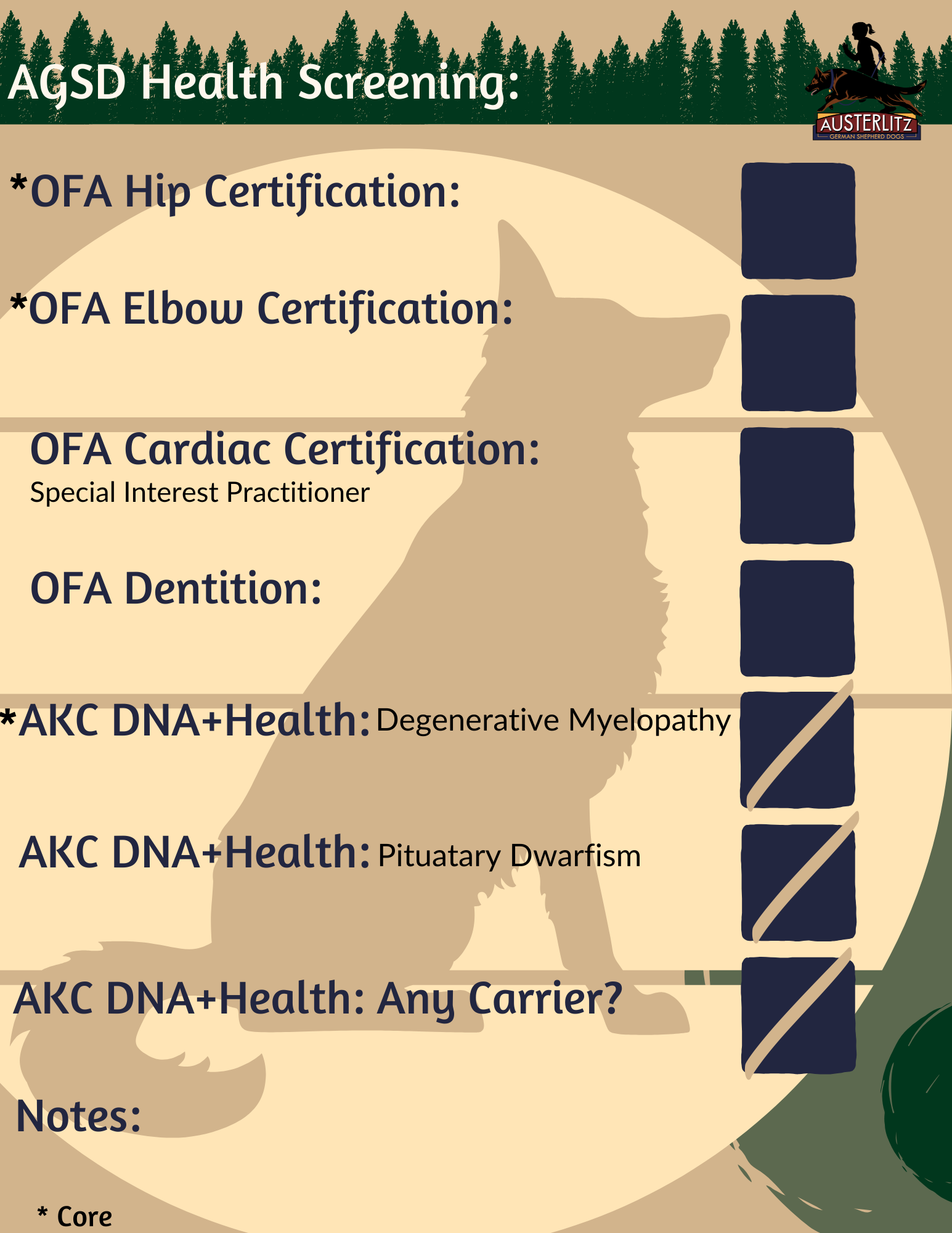
5 Health Conditions: The predisposition to certain health condition is also generally accepted to be inherited. Breeders have long avoided breeding dogs with certain health conditions together, even when those conditions are not clearly understood and evidence for inheritance is absent. While puppy seekers don’t need a crash course in genetics to find a puppy bred for good health they do need to understand that there are worldwide standards for health “best practices” for decreasing heritable health conditions in purebred dogs and that we at AGSDs follow these recommendations marked below with *(specifically the FCI, WUSV, and SV guidelines as these are evidence based and set recommendations for kennel clubs worldwide) including guidance from the GSDCA as the parent club for the USA. We screen all breeding dogs for hips, elbows, heart, plus DNA testing for DM (among others) and for normal bite/dentition.
As part of your decision making process, please ensure you have visited the parent dog pages to see a complete list of performed health screenings and links to each dogs results on the organization website. By confirming health screenings results via the organization website, you can be confident the test was actually performed! We also include a health screening summary as a quick reference. If you have questions about any of the health conditions you can find detailed explanations on the Orthopedic Foundation For Animals website.
We NEVER skimp on health and do all health testing recommended by the Orthopedic Foundation for Animals for the German Shepherd Dog (hips, elbows, plus optional testing for degenerative myelopathy and cardiac screening).
Additionally, our pedigrees are 100% health tested going all the way back to the first health testing started in Germany in 1954. We NEVER include any dog in our breeding program that does not have a 100% health tested pedigree, because untested dogs have unknown health status they can pass on a predisposition for disease even though parents are normal. Breeding for health is difficult enough without increasing the unpredictability of a pedigree.
While all of these health and behavior traits are a "Predisposition For" the trait, we are committed to influencing those we can using the breeder skills of selection pressure, while still maintaining a vital and diverse gene pool via an expansive breeding method. Expansive breeding prioritizes a large gene pool and keeping as many good individuals within the breeding program.
We expect our clients to be just as committed to good outcomes by understanding the role of the environment (everything around the dog throughout their life) in their puppy’s outcome. We cannot influence anything once a puppy leaves our home, from that point forward you are responsible for your puppy’s long term health and behavior. Make choices wisely.
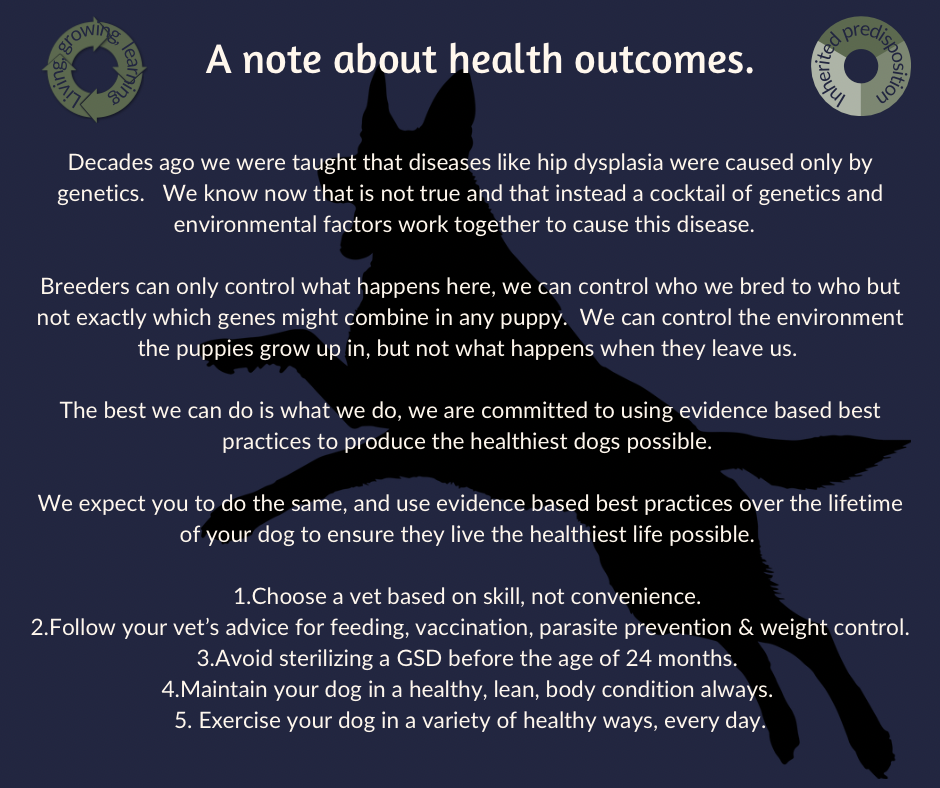
Before you decide if we are the breeder for you, we want you to understand how important behavioral and physical health are to us. So important we have designed systems for tracking these traits, and communicating clearly what we know to you.
While this is our system, you can apply what you learned here to your interviewing of any breeder, so that in the end you bring home the puppy you want and that is right for your needs.