When we started testing our dogs for degenerative myelopathy about a decade ago we knew we would likely find the mutated gene in some of our dogs because we had produced two dogs diagnosed with DM in the past. So, odds were, because our program is not created new every generation with dogs we bought but was built upon generations of our own bloodlines that somebody would at least carry the mutated gene that causes the horrendous disease. I wasn't worried about that, but I was worried I might find one of my dogs had two versions of the "bad" gene and so might develop the disease.
I was happy to discover that most of my dogs didn't carry the gene at all and were homozygous (both genes the same) for the normal version of the gene.
I was happy to discover none of my dogs were homozygous at risk/at risk and so had a chance of developing the disease. This was a huge relief.
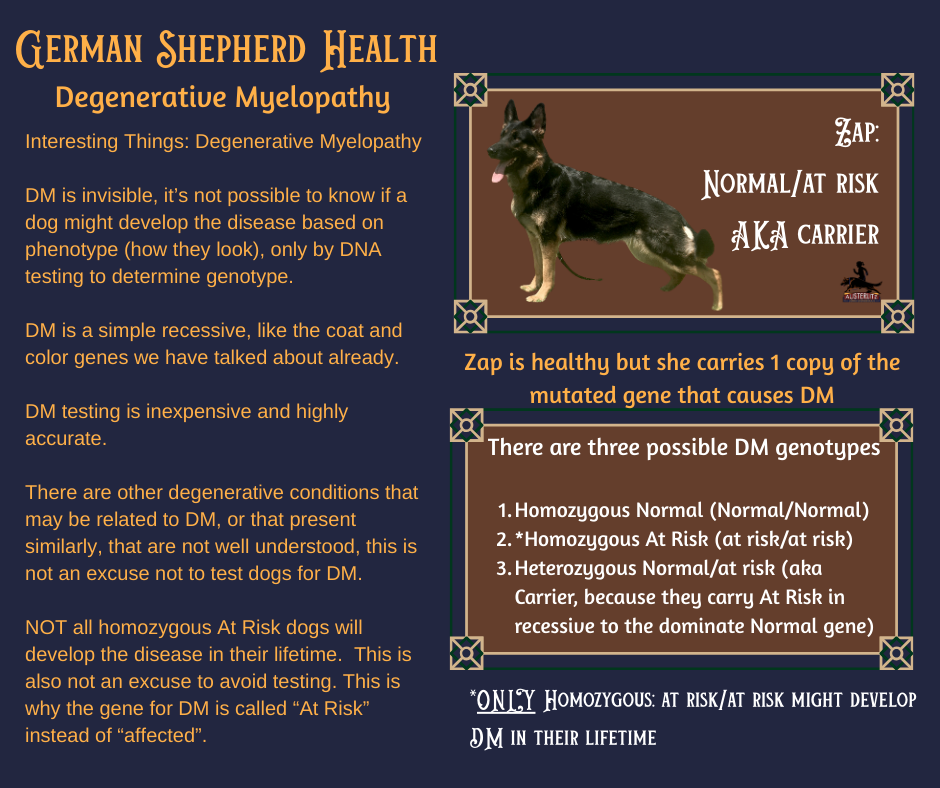
I was ok with a few carriers, and of that first round of DM testing we did the (then) young dog Zap was the only one that moved forward in the program.
I knew I wanted to remove the mutated gene from the program, or at least stage my breedings so that no "at risk" puppies could be born. That was easy, nobody WANTS to produce a puppy that might develop a fatal disease.
But I also didn't want to throw good dogs out of the gene pool, because even then I knew that genes and a diversity of genes, were vital to my program. To get genetic diversity you have to have lots of different dogs, not just a few "perfect" dogs or a few "outstanding" dogs, that is a lie.
To protect a breed, or even on micro scale a breeding program, you need a lot of different dogs and while this goes against the "best of the best" competition based model of breeding we have been taught is "ethical" as time passes we see with increasing clarity how damaging a competitive breeding model as been to the GSD breed, among others.
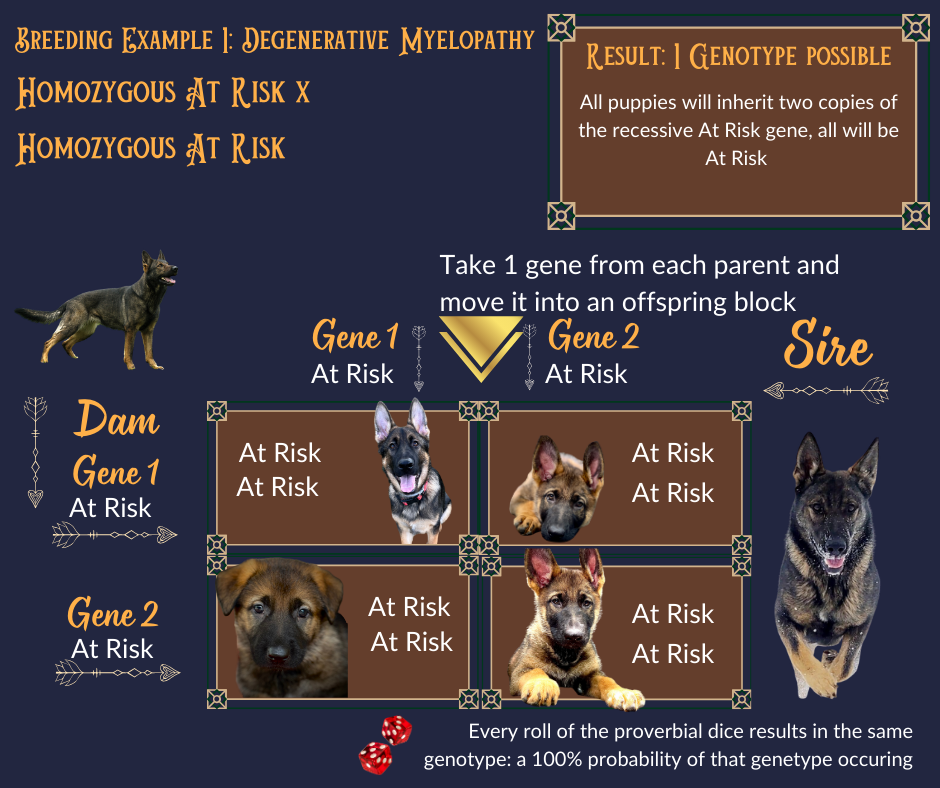
So, no, I wanted to include Zap despite her carrier status, I just wanted to ensure none of her offspring would be homozygous at risk and inherit the potential to develop DM.
Because the overall rate of DM in the GSD breed was around 25% homozygous at risk (at that time) it's actually easy to arrange good breedings in such a way that at risk dogs are not possible. In other breeds, like the PWCs we love so much, the rate of homozygous normals is so extremely low that those breeders must make different choices to preserve their breed. But for GSD breeders this work is easy, inexpensive, and we should demand a rapid decrease in the presence of the mutated gene among our most influential dogs.
We were fortunate that we had a homozygous Normal/Normal stud dog in the form of Kiro v Vierra and further the stud dogs we bred out to during that time were also chosen for their homozygous normal status (among suitable options). This meant that as time has passed we now have a breeding program almost exclusively of dogs who are homozygous normal/normal and who cannot pass on the mutated at risk gene because they do not posses it.
Current generation DNA testing has yielded one heterozygous (normal/ at risk) carrier, a Zap son, Ultimo v d burg Austerlitz who is yet unbred and may stay that way because we have his full brother Ursus v d burg Austerlitz and maternal half sister Narada, both of whom are homozygous normal/normal.
BUT, the brothers, Ultimo and Ursus are different dogs, with different genes and traits. So, because I value genetic diversity I'm keeping Ultimo in consideration, and when bred to a homozygous normal/normal female I can keep a homozygous normal offspring if I want to move forward Ultimo's genes without moving forward the mutated DM gene.
I will add that I initially resisted DM testing, when it first came out, because I believed that DM wasn't a problem for the GSD breed, or my program, having never experienced it. I was also worried the testing was imperfect, because many breeders said it was, and because there was so much talk around "other" forms of DM that might not be caught, or might be mis caught?
But then a dog we had produced was diagnosed with DM and he lost his life so very young (age 6) and his family experienced so much sadness, and that broke my heart in a good way. The very day I got the news I decided to buy the tests and test all breeding dogs going forward. Another dog was later diagnosed with DM and that cemented that I made the right decision.
It's an easy, inexpensive test, the science is good and while not perfect that was no good reason for me to resist. While that would not have changed anything, because both affected dogs were bred years before the test was available, I could change things going forward.
So I did, and because it has over a decade now, and some of the dogs we tested were older, I feel confident that nobody else with a dog from our program will have to loose their dog to this disease as it's identified for the test available.
If you want to learn more about DM you can read about it here and there are lots of companies that offer DM testing for dogs, we have used Gen Sol (which is still a very budget friendly option), Embark, and we are currently using AKC DNA + Health.
The mutated gene is a simple recessive gene, meaning we can work with it along with color and coat in our German Shepherd basics series.
It's important to note that only dogs with 2 copies of the At Risk (mutated) gene might develop DM in their lifetime, but not all will.